‘Frightening situation’: Bangladesh elections haunted by political violence
At least 16 political activists have been killed since elections were announced in December, prompting fears of a return to a climate of violence many Bangladeshis had hoped was behind them.
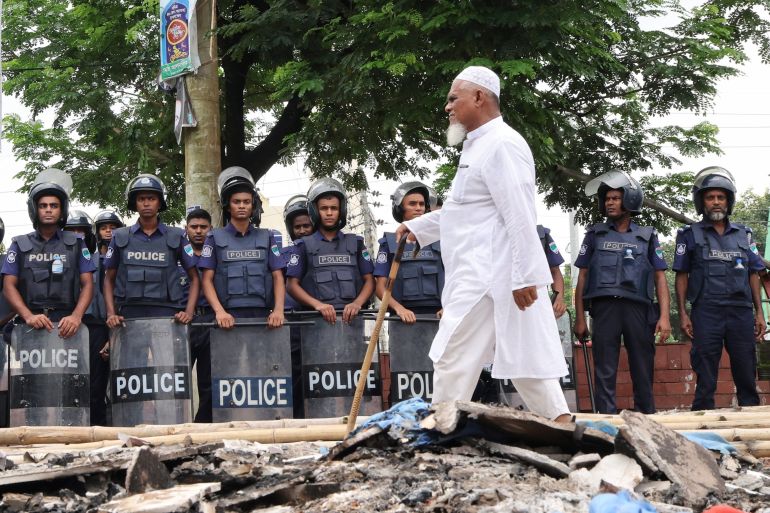
Dhaka, Bangladesh – When Kazi Shawon Alam learned that Azizur Rahman Musabbir, a fellow Bangladesh Nationalist Party (BNP) activist, had been shot dead on January 7, it confirmed to him what many political organisers already felt before Bangladesh’s February 12 parliamentary elections: Campaigning had become dangerous.
Musabbir’s killing felt personal. Shawon had gone to jail with Musabbir four times under the government of former Prime Minister Sheikh Hasina, which was widely accused of brutal crackdowns on the political opposition, including through mass arrests, killings and forced disappearances.
Recommended Stories
list of 4 items- list 1 of 4Bangladesh slams India over fugitive ex-PM Hasina’s first public address
- list 2 of 4Making sense of Bangladesh’s ‘Hadi effect’ shaping the vote
- list 3 of 4Bangladesh adamant on playing T20 World Cup in Sri Lanka despite ICC threat
- list 4 of 4Campaigning begins in Bangladesh for first election after Hasina’s ouster
That era of fear, many Bangladeshis believed, had ended with Hasina’s ouster in the popular student-led uprising, which forced her to flee to India on August 5, 2024.
But while the interim government of Nobel Laureate Muhammad Yunus, who replaced Hasina, is not accused of orchestrating any such excesses, political violence in Bangladesh is surging again before the upcoming vote.
“Police say there was no political motive [behind Musabbir’s killing], but fear doesn’t disappear,” said Shawon, a leader of the BNP’s student wing in the capital, Dhaka. “We don’t want killings or confrontation with anyone. But the reality is, during elections, violence feels inevitable.”
Bangladesh is heading to the polls for the first time since Hasina was removed from power, ending more than 15 years of hardline government. The Yunus interim government is overseeing a vote that coincides with a referendum on state reforms, with about 120 million voters eligible to cast ballots in the South Asian nation of approximately 170 million people.
Yet, a series of killings, threats and street clashes is reviving fears of a return to past election-season violence, which Bangladesh has routinely grappled with since its 1971 independence from Pakistan.
Across Bangladesh’s 300 constituencies, the BNP is leading a coalition of 10 like-minded parties. Meanwhile, the Jamaat-e-Islami, also known as the Jamaat, is heading a separate 11-party alliance, which includes the National Citizen Party, a group formed by students who led the anti-Hasina movement.
Outside these blocs, the Islami Andolan Bangladesh, which broke away from the Jamaat-led alliance, and the Jatiya Party, a longtime ally of Hasina’s Awami League (AL), are contesting independently. The AL itself is absent from the election as Yunus’s administration banned its political activities in May 2025.
But while these parties represent diverse ideological platforms, a spate of killings and violent attacks across the country is sparing none of them.

Targeted killings, violence rise
Hasan Mollah, 42, a local BNP leader in Keraniganj on the outskirts of Dhaka, was shot on Friday, January 23, while sitting at a neighbourhood election office. He died a day later in a Dhaka hospital, with the motive for the killing unclear.
Mollah was the 16th political activist killed since the Bangladesh Election Commission announced the election schedule on December 11, according to local media reports.
Days earlier, a ward-level leader of the Jamaat, 65-year-old Anwarullah, was killed at his residence in Dhaka’s West Rajabazar neighbourhood, during what police described as a burglary.
The deaths followed the December killing of Sharif Osman Hadi, a youth leader who emerged as a prominent face of the 2024 protests and was preparing to contest a parliamentary seat in central Dhaka.
Hadi was shot on December 12, a day after the election schedule was announced, by gunmen on a motorcycle and later died on December 18 in a Singapore hospital, triggering unrest and renewed security concerns nationwide.
None of the killings has been officially classified as politically motivated. Yet, for party activists, that distinction offers little reassurance.
Local media and rights groups say BNP leaders and activists account for 13 of the 16 deaths recorded since the election schedule was announced. The others include Hadi, Jamaat leader Anwarullah, and a leader of the banned AL youth wing, Jubo League.
Seven of the victims were shot dead, underscoring the widespread presence of illegal firearms, reports Prothom Alo, a Bangla daily.
Government data show that of the 3,619 weapons looted from security forces during the 2024 uprising, about 1,360 remain unaccounted for, along with a large quantity of ammunition, despite security forces recovering more than 60 percent of the stolen arms before the polls.
Meanwhile, at least 62 election-related clashes have been recorded nationwide since the election schedule was announced, according to a report by the Human Rights Support Society (HRSS).
For many Bangladeshis, these deaths revive bitter memories of decades of political violence.

A familiar history
A comparative mapping by the Bangladesh Peace Observatory (BPO), an election-violence monitoring initiative run by the Dhaka-based Centre for Alternatives, shows wide variations in election-period deaths over the years.
Using a standard pre- and post-election window, the BPO recorded 49 deaths around the 1991 election, 21 around the 2008 vote, and 142 around the 2014 polls, an election boycotted by the main opposition BNP and Jamaat.
Subsequent elections in 2018 and 2023, held under Hasina’s government, were widely described by rights groups and opposition parties as one-sided, with limited contestation.
Violence, nonetheless, persisted. Before the 2018 election, United Nations human rights experts documented 47 incidents of election-related violence in four days, leaving eight people dead and more than 560 injured.
During the 2014 vote, at least 21 people were killed on polling day, and voting was halted at about 400 centres.
This history, said analysts, helps explain why fear remains high as Bangladesh heads into its first genuinely competitive election since Hasina’s removal from power.

Threats from within
In some constituencies, the danger comes from within political parties themselves.
In the central district of Tangail, Tusher Khan, a 24-year-old BNP student wing leader, said he filed a complaint with local police after receiving threats from a senior BNP figure aligned with a rival candidate.
“They told me they would break my arms and legs if I stayed active in the campaign,” Khan told XEn News.
The dispute centres on a seat where a former BNP minister is running as an independent against a BNP-nominated candidate. Khan said the intimidation was aimed at keeping rival supporters away from polling centres on election day.
Abdul Latif, the local BNP leader accused of issuing the threats, acknowledged confronting Khan, but dismissed the complaint. “He defamed our candidate,” Latif said. “We will not spare anyone who provokes us.”
According to Prothom Alo, 92 BNP leaders remain in the race as rebel candidates across 79 constituencies. Jamaat has one rebel candidate.
Analysts say constituencies with rebel contenders are more prone to violence before the vote.
Local media reported clashes among supporters of BNP candidates in four districts on Saturday alone, leaving more than 100 people injured.

BNP vs Jamaat: Clashes spill onto the streets
Political tensions have increasingly spilled into public view as campaigning intensifies.
A clash broke out in Dhaka’s Mirpur area on the evening of January 20, leaving about a dozen people injured, a day before formal campaigning began, after two female activists of Jamaat “incidentally” went to a BNP leader’s apartment as part of electioneering.
Jamaat chief Shafiqur Rahman is contesting the parliamentary seat from that densely populated neighbourhood against a BNP candidate. Since then, residents say fear has lingered as rival activists maintain a visible campaign presence in the locality.
“This is really a frightening situation for ordinary voters like us,” said Abdullah Al Mamun, who lives about 500 metres (547 yards) from the site of the violence. “We don’t want clashes. We just want to vote peacefully.”
BNP and Jamaat leaders have accused each other of intimidation, and have both criticised the Election Commission for failing to act decisively.
“We fear violence as election day approaches,” said Jubaer Ahmed, a Jamaat leader. “Our activists are being intimidated across the country, our campaigns are being obstructed, and in Mirpur, our women activists were attacked.”
However, from the BNP side, Saimum Parvez, a party leader involved in election coordination, alleged that Jamaat activists were collecting voter information illegally.
He also said recent killings of political activists should not be dismissed as internal disputes. “Some of these may be targeted killings meant to disrupt the election,” he told XEn News.
He accused Jamaat of spreading online disinformation, which is spilling out into offline tensions, and warned that any perception of a “managed election” would only increase the risk of violence.

A festival, yet harder to control
Police say street confrontations are becoming harder to prevent nationwide as political activity expands.
A police officer in Kurigram, a northern district near the Indian border, said rival BNP and Jamaat groups came face to face during door-to-door campaigning at two locations following Friday prayers, forcing police to intervene.
“After many years, elections feel like a festival again,” the officer told XEn News, speaking on condition of anonymity. “More ordinary people are getting involved, but that also means confrontation risks have increased. Police can’t be everywhere at once.”
AHM Shahadat Hossain, additional inspector general (media and public relations) at Bangladesh Police headquarters, said authorities are closely monitoring the law and order situation before the vote.
“Overall, the situation is under control,” he told XEn News, adding that extra precautions have been put in place in vulnerable areas.
Hossain acknowledged that some weapons looted during the July 2024 unrest remain unrecovered. “Preventing their use in election-related violence is a top priority,” he said.
About 900,000 personnel, including 108,730 members of the military, will be deployed from February 8 to 14 to ensure security for the elections, according to Jahangir Alam, the acting head of the Ministry of Home Affairs.
Authorities say that more than half of the country’s 42,761 polling centres, which have been classified as risky, will receive the bulk of additional security forces.
Addressing the recent killings and clashes, Hossain said police are investigating incidents as criminal acts, regardless of political affiliation. “Those involved will face legal action,” he said, adding that police would act “professionally, impartially and firmly” to protect lives and voting rights.
Officials in the office of interim leader Yunus say violence so far remains lower than in past national elections, citing tighter coordination among security agencies.
While briefing foreign diplomats in Dhaka on Sunday, Chief Election Commissioner A M M Nasir Uddin said the election body would put in place robust security measures to ensure a peaceful vote.
As the briefing was under way, local media reported a clash between Jamaat and BNP supporters over electioneering in Lalmonirhat, a northern district near the Indian border, which left about 20 people injured.
From exile in New Delhi, former Prime Minister Hasina on Saturday urged her supporters to overthrow the Yunus-led government, injecting further political tension before the vote.
Against this backdrop, election watchdogs remain concerned about the credibility of the February 12 vote.
Badiul Alam Majumdar, the head of the citizen platform SHUJAN, warned that rising intolerance could undermine the process. “The real challenge,” he said, “is whether official assurances can overcome fear rooted not only in current events, but in history.”